
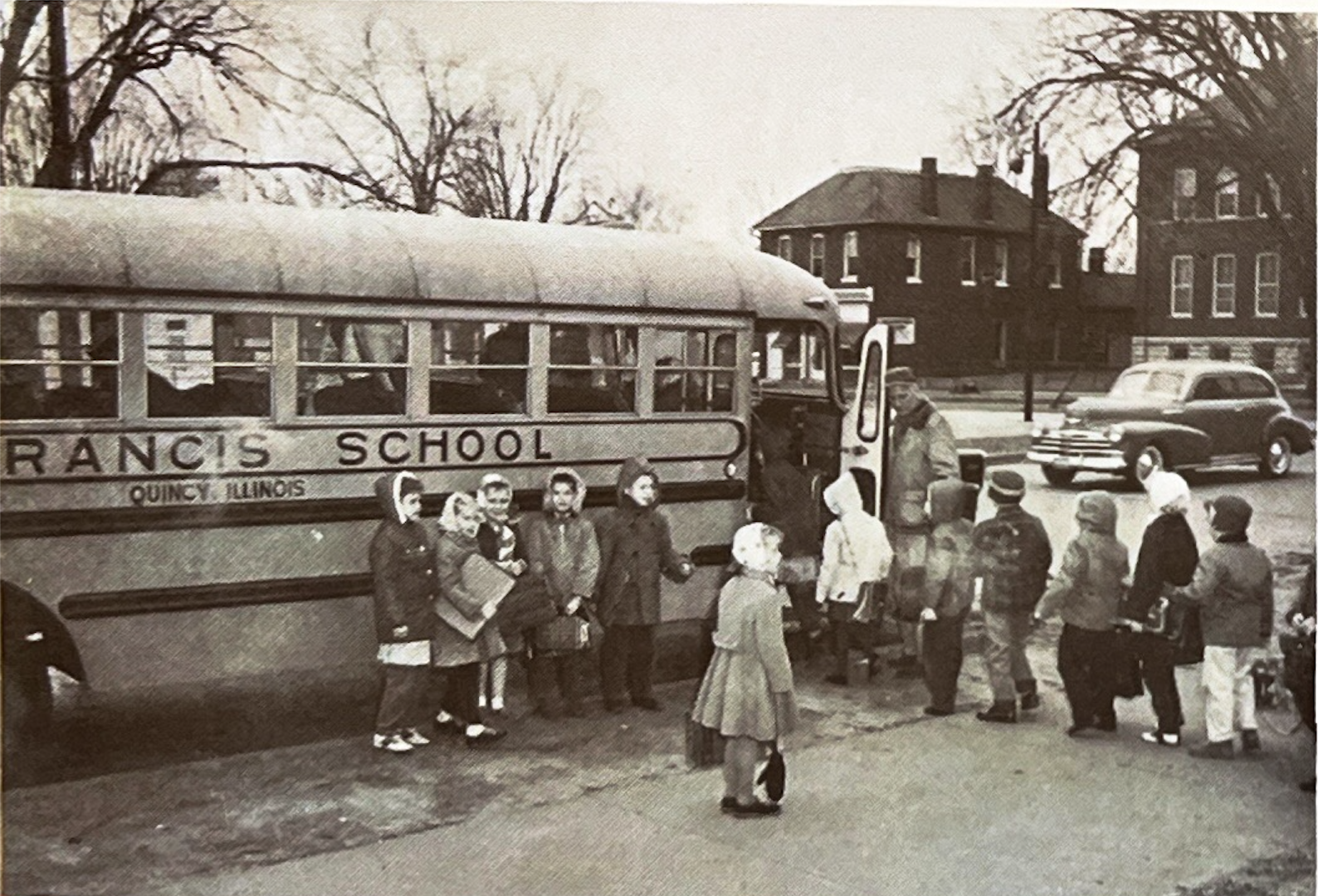
It started with forty children and a borrowed building
On the morning of March 6, 1862, about forty children walked over from St. Boniface school to a vacant orphanage building on College Avenue. That was the first day of St. Francis Solanus School.
The Franciscans had come to Quincy to start a college, and they did. But experience proved that a high school was premature, as the parish history puts it, and what the neighborhood actually needed was an elementary school. So they opened one alongside the college, in the building they had. Tuition was thirty-five cents a month. There was no school in August.
The first principal was Friar Maurice Klostermann, who had taught for twelve years in Germany before he became a Franciscan. Four years later the School Sisters of Notre Dame took charge, beginning with two of them: Sister Mary Gerardine and a candidate named Barbara Herrmann. Their order was still teaching here a hundred and nineteen years later.
In 1920 the school stopped charging tuition
Not discounted. Free. In its place came a monthly envelope, four dollars a family, and the school has been carried by the parish rather than by the door ever since.
The pastor's stated reason was blunt: he wanted Catholic children out of the public schools. But the arrangement he chose outlasted the argument for it. Every family at St. Francis today receives parish support, and that is not a program the parish adopted at some point along the way. It's how this school has been paid for since 1920.
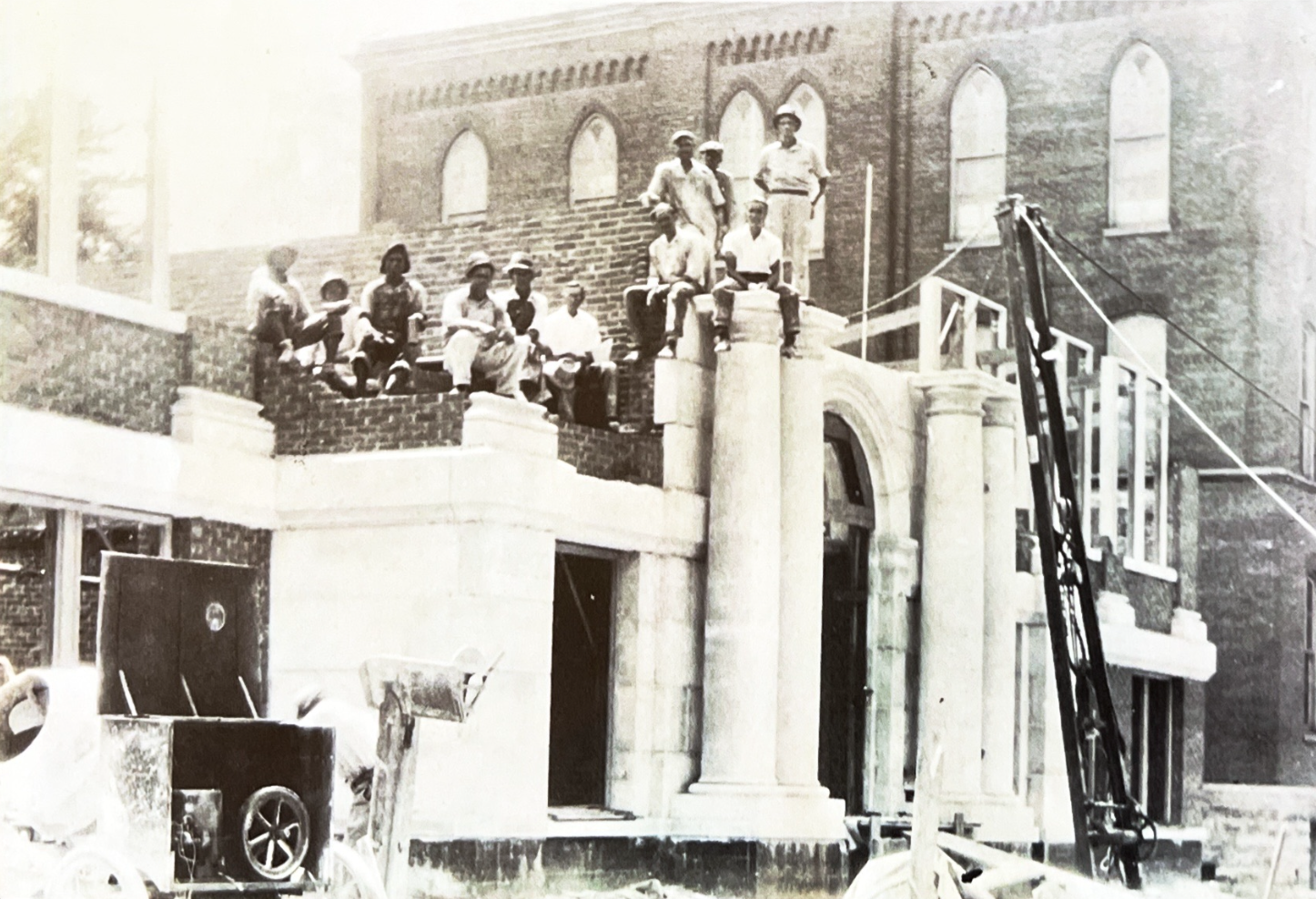
They built this school in the worst year anyone ever picked to build one
By 1930 the school had outgrown its second building so badly that two classes were meeting in the Sisters' convent. That March, Fr. Optatus Loeffler invited fifty men of the parish to breakfast in the school basement and told them he wanted two hundred thousand dollars.
He also ran an essay contest for the children. The assigned topic was "Why We Need a New School," and the parish history is refreshingly blunt about the strategy: parents who helped their children argue for the school would talk themselves into pledging. It worked. More than ninety thousand dollars was pledged, payable over two years, in the first full year of the Great Depression.
If one nail would do, use two.
The architect's rule
Ground was broken on May 12, 1930, and Bishop Griffin dedicated the school on May 3, 1931. The four columns at the entrance are a single stone apiece, two tons each. Only half of it went up: the old school was still standing in the way, and the money had run out. The west wing was finished in 1952 and the kindergarten added in 1953. Your child would go to school in that building.
We started out sharing a room with Quincy University
Fr. Servace Altmicks was the first president of what is now Quincy University and the first pastor of St. Francis, at the same time. When he decided the neighborhood needed a grade school, he opened it inside the building his college classes were already using. Both institutions are named for the same Spanish missionary: St. Francis Solanus, who by legend would play music to gather a crowd before he preached to it.
For the next several years the college students and the grade school children went to school under one roof, and in 1865 they moved into a new schoolhouse together. By 1870 the grade school had grown enough that the college had to move out and put up a building of its own.
We're still across the street from one another. Our fifth through eighth graders walk over to the university chapel for speakers, and the university is where our students would go if we ever had to clear the building. It's the sort of arrangement a hundred and sixty years of being neighbors gets you.
There's a St. Dominic's because there was a St. Francis
St. Boniface paid to start this parish out of its own treasury in 1860, and in 1862 forty of its children walked over to fill the new school. A century later we were asked to do the same thing for someone else.
The bishop decided the east side of Quincy needed its own parish, and St. Francis was told to build it. Plans were drawn in 1962 for a plant on Columbus Road: a school, with a gymnasium that would serve as the church on Sundays, at a cost of half a million dollars. Ground was broken in March 1963, and in September 1964 our families living east of Thirtieth Street enrolled their children at St. Dominic's instead of here. The debt reached about $382,000. The parish held a breakfast, launched a drive, and paid it off; the two parishes formally separated in 1977.
The parish history is matter-of-fact about why we were asked: St. Boniface had done as much for us in 1860.
What hasn't changed
Sister Merici taught in this school for fifty-eight years. She walked over from the convent every morning, spent eight to ten hours in the classroom, and stayed up half the night correcting papers. When the parish threw her a jubilee in 1950, the account notes that nothing was further from her mind than a celebration. In her own eyes she had done nothing worth rejoicing over. Her former students gave the church a statue.
A good deal has changed since. In 2020 the Franciscans handed the parish to the Diocese of Springfield, and for the first time in a hundred and sixty years the pastor of St. Francis was not a Franciscan. We kept the heritage; we're still named for a Franciscan missionary and we still teach like one. In 2025 our school joined Quincy's three other Catholic elementary schools under a single set of bylaws, a decision made about the next century rather than this year.
So no, we're not that school in the obvious ways. The Sisters are gone, the teachers are lay men and women, and nobody builds classrooms for eighty children anymore.
But the arrangement underneath is the one from 1862: a parish that decided its children would be taught here, and has paid for it together ever since.
A hundred and sixty years, briefly
The milestones, from a borrowed orphanage building to Quincy Catholic Schools.
-
Forty children walk over from St. Boniface. The school opens in a borrowed orphanage building. Tuition is thirty-five cents a month.
-
The first purpose-built schoolhouse opens on College Avenue, a frame building that held eighty children to a classroom.
-
The School Sisters of Notre Dame take charge of the school.
-
The grade school has grown enough that the college moves out and builds a hall of its own.
-
Fifth, sixth, and seventh grades are added.
-
A second school opens: eight classrooms, and an auditorium on the third floor.
-
The Sisters move into the convent across from the church.
-
St. Michael's opens as a country school for farm children who can't reach town over unpaved roads. It runs until the 1960s.
-
The parish makes the school free and supports it by monthly family envelope.
-
The present school is dedicated. The parish pledged the money in the spring of 1930 and paid it off through the first years of the Depression.
-
The 1893 school, which had stood in the way of the new one, comes down. The site becomes the playground and later the west parking lot. A newspaper article at the time noted how difficult the demolition was because of the "honest materials and workmanship that went into the structure."
-
The west wing is finished at last, and the kindergarten added.
-
St. Francis builds St. Dominic's for the east side of Quincy, and our families east of Thirtieth Street enroll their children there.
-
The School Sisters of Notre Dame mark one hundred and nineteen years of teaching at St. Francis.
-
Preschool is added, making St. Francis the PreK–8 school it is today.
-
After a hundred and sixty years, the Franciscans hand the parish to the Diocese of Springfield. Fr. Arisman becomes the first pastor in the parish's history who is not a Franciscan.
-
St. Francis joins Quincy's other Catholic elementary schools under one set of bylaws as Quincy Catholic Schools.
A few things we found in the old parish books
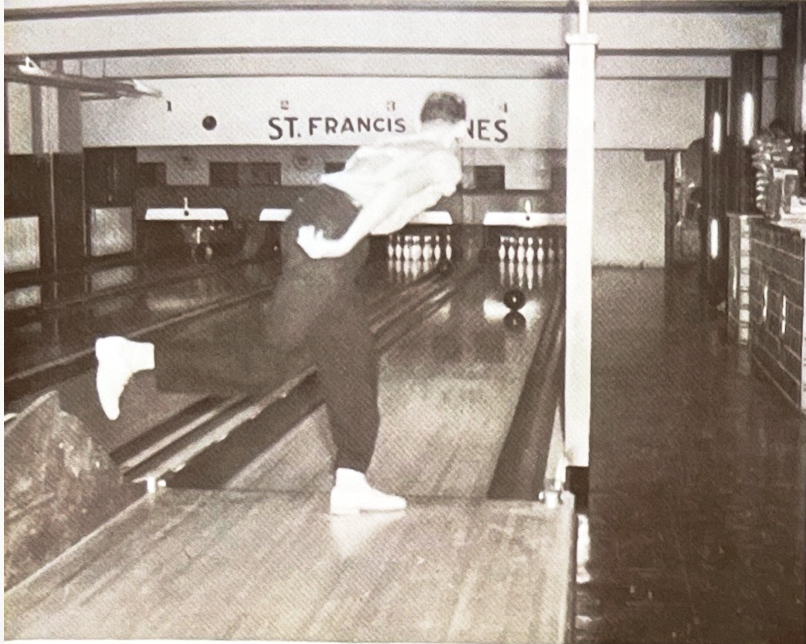
The school we're in now had very popular bowling alleys in the basement. That room became the Tuesday Club Room, and in 2026, the School Library.
Tuition in 1862 was thirty-five cents a month. It went up to forty cents in 1864, and the parish history blames inflation.
There was no school in August.
The school before this one had a tower a hundred and twenty feet tall and a third-floor auditorium that seated a thousand people. It stood on the site until 1946, which is why the present school was built only half its eventual width.
The four stone columns at the front door are a single piece of stone apiece, two tons each. The architect's rule was that if one nail would do the job, use two.
The auditorium balcony rests on a sixty-four-foot steel beam, the longest in Quincy when it went in.
The plans for the 1865 schoolhouse cost twenty-five dollars.
That schoolhouse was built to hold eighty children in a classroom.
Sister Merici taught here for fifty-eight years.
Come see the building.
The best way to understand a school is to walk through it while it's running. We'll show you around.