As a kid, I enjoyed Christmas stories (I also do now). I remember going for Christmas Mass on the day of Christmas. I was hoping to hear some Christmas narratives during the Gospel reading, but I did not. What I got from the reading was that the Word was made flesh and dwelt among us. Back then, it did not make much sense.
Actually, the Christmas story is not read as a Gospel passage during the Mass on the day of Christmas. Why? The Liturgy of Christmas prescribes four Masses: the vigil Mass, the Mass at night, the Mass at dawn, and the Mass during the day. Each of these Masses has specific readings. One fulfills the obligation of attending Christmas Mass when one participates in any of them.
While the Gospel readings in the vigil Mass, the night Mass, and the one at dawn tell the Christmas story, that of the Mass during the day gives a theology of Christmas. While the readings on the Christmas story focus on the birth of the child against the backdrop of God’s salvation history, the reading on the Christmas theology ponders the identity of the child against the backdrop of cosmic history. By doing so, it proclaims that the newborn child will have cosmic significance.
In the lines that follow, I will summarize the Christmas story based on the Gospel readings of the vigil Mass, the night Mass, and the Mass at dawn. The essence is to supply that longing for the Christmas story for those who attend the Mass of the day. Secondly, to give a comprehensive view of the Christmas story for those who participate in any of the three Masses. Since each of the Christmas readings has specific readings, making a summary of the individual Gospel narratives will give one a sense of the Christmas story in a more comprehensive manner.
The Gospel reading of the vigil Mass comes from Matthew 1:1-25. It begins by giving us the genealogy of Jesus down to Abraham. By tracing the history of Jesus 42 generations (cf. Mt 1:17), the Gospel narrator illustrates the humanity of Christ. Having established this, the Gospel passage narrates how the angel of the Lord appeared to Joseph and instructed him not to divorce Mary, whom he had found to be pregnant. The angel further disclosed to him that Mary was conceived of the Holy Spirit and that the child to be born must be named Jesus.
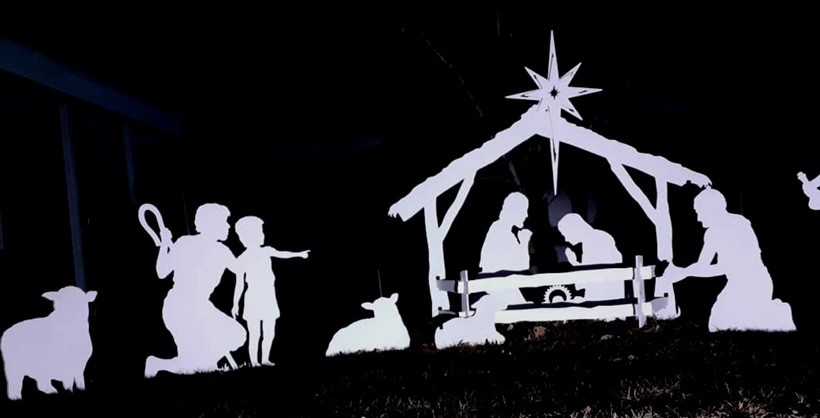
The Gospel reading for the Mass at night is taken from Luke 2:1-14. The Gospel narrator tells us that Joseph and Mary left their dwelling place, Nazareth in Galilee, to their homeland, Bethlehem in Judea, to accomplish the compulsory enrollment. There in Bethlehem, Mary gave birth to Jesus in a manger since there was no place for them in the inn. The passage further narrates that the news of the birth of the new baby was announced to the shepherds keeping watch over their flock that night by the angel of the Lord.
The Gospel reading for the Mass at dawn (Lk 2:15-20) is a continuation of that of the vigil Mass. When the angels went away from them, the shepherds hurriedly went to Bethlehem. They saw and confirmed the veracity of the angelic message for themselves. They made it known to Joseph and Mary. They returned to their duty post glorifying and praising God.
With these narratives in mind, the Gospel reading during the day (John 1:1-18) is set on the background that the child is born. So, it does not focus on how the child was born but on what the birth of this child is for us.
Fr. Kenneth Ahanonu