It began with a debt somebody insisted on paying
In 1858 the first Bishop of Alton sailed to Europe looking for priests. German Catholics were pouring into Illinois faster than he could serve them, and in Paderborn he found a twenty-six-year-old Franciscan provincial who wanted to be a missionary himself. He couldn't leave his post, so he sent nine friars instead. They landed in New York in September 1859 and took an immigrant train west.
What brought them to this corner of Quincy was a man named Christian Borstadt. Years earlier he had been a traveling artisan in Germany, and at Fulda he fell seriously ill with nowhere to stay. Franciscan friars took him in and cared for him until he recovered. He never forgot it.
Since then I always thought that if I could ever do anything good for the Franciscans, I would do it willingly.
Christian Borstadt
When the chance came he said so plainly: if the friars came to Quincy, he would give them a site for a church and a convent. It was a block at Eighteenth and College, then called Vine Street, out where the city stopped and the prairie started.
Two friars came up from Teutopolis on December 2, 1859: Fr. Servatius Altmicks and Brother Honorius Topp. Two days later, on the second Sunday of Advent, Fr. Servatius stood in the pulpit at St. Boniface and told the congregation what was going to happen. Four men met in the rectory that same afternoon to work out how. Before the month was out they had rented a building at Maine and Eighth: school on the ground floor, the friars lodged in the middle, the chapel on top.
Two things were asked of the friars on Borstadt's ground: a parish, and a school of higher learning. They said yes to both. One became this parish. The other became Quincy University.
Snow blew up the aisle at the first Mass
The 1860 building was not a success. The architect was a local carpenter who had never built a church, and the walls came out so weak that the roof threatened to bring the whole thing down. Iron rods were run through to hold it together and brick buttresses propped it up outside. The slender Gothic tower he had drawn was out of the question; a box shaped like a chimney held the bell instead.
There was no money for anything better. The summer had been dry, the Catholics of Quincy were already building an orphanage, and the pastor who organized it all held that borrowing brings sorrow, so nothing was borrowed. St. Boniface gave a thousand dollars outright, and another eight hundred before the year was out, because the new parish could not raise it.
Bishop Juncker laid the cornerstone on the afternoon of July 2, 1860. That same morning, at St. Boniface, he had ordained three young friars to the priesthood, the men who would do the teaching and the burying here for the next twenty years.
The parish was born at the Christmas Midnight Mass of 1860. The temporary doors wouldn't close, and snow swirled up the aisle during the liturgy. Few German Catholics lived that far from downtown yet, so ten benches had been put in. They were not full.
They bought this church a quarter at a time
By the 1870s the parish had outgrown its propped-up church and had no means to replace it. So in 1874 Fr. Nazarius Kommerscheid organized the St. Francis Building Society, and every wage-earner in the parish began putting in twenty-five cents. They kept it up for nine years and accumulated the fund in gold.
Fr. Nazarius never saw it spent. He began coughing blood in August 1883, was sent south for the climate, and died on a train near Dallas that October at forty-eight. The schoolchildren of St. Francis put up a stone marker to him in St. Boniface Cemetery.
By January 1884 the fund stood at thirty thousand dollars, and the bishop wrote to say it was time.
I wish you to commence with the erection of the new St. Francis' Solanus Church as soon as practicable, immediately if possible.
Bishop Baltes, January 1884
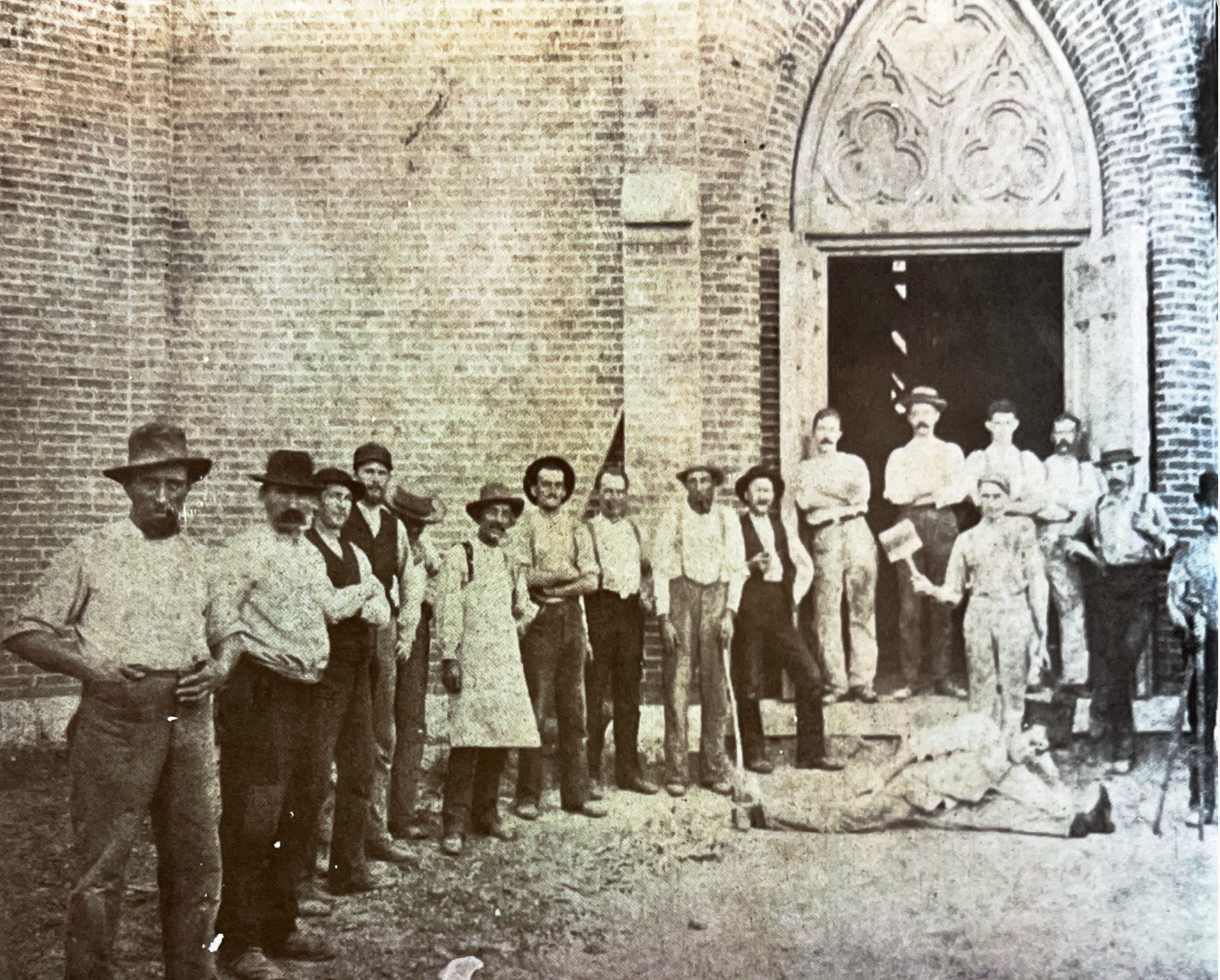
The first sod was turned that July. The church you're standing in went up between 1884 and 1886, designed by Brother Adrian Wewer, a Franciscan who drew more than a hundred churches, schools, rectories, hospitals and motherhouses across the country and never once accepted payment for any of them. It runs 182 feet long, seventy across the nave and a hundred and twenty across the transept, and the steeple reaches 200 feet. The stone and brick came from Quincy; the carved stone came from Joliet. It cost about $62,000. Writing in 1985, the parish history still called it the largest parish church in the Diocese of Springfield in Illinois.
It was dedicated on October 24, 1886. The steeple flew papal and national flags, the church was hung with garlands, and the neighbors decorated their own houses and the streets so as not to be left out. The procession formed around eleven and included Catholic societies from as far as Canton and Hannibal. The whole thing ended with everyone singing "Holy God We Praise Thy Name." The old church was pulled down that summer.
There is a story, and the parish history says the legend seems to be true, that when Bishop Baltes was shown the plans in January 1884 he picked up a pair of scissors, cut one bay off the drawing, and said the church was large enough. If so, the parish paid for it in acoustics: it was hard to hear in here for the better part of a century, until the sound system was improved.
December 22, 1899
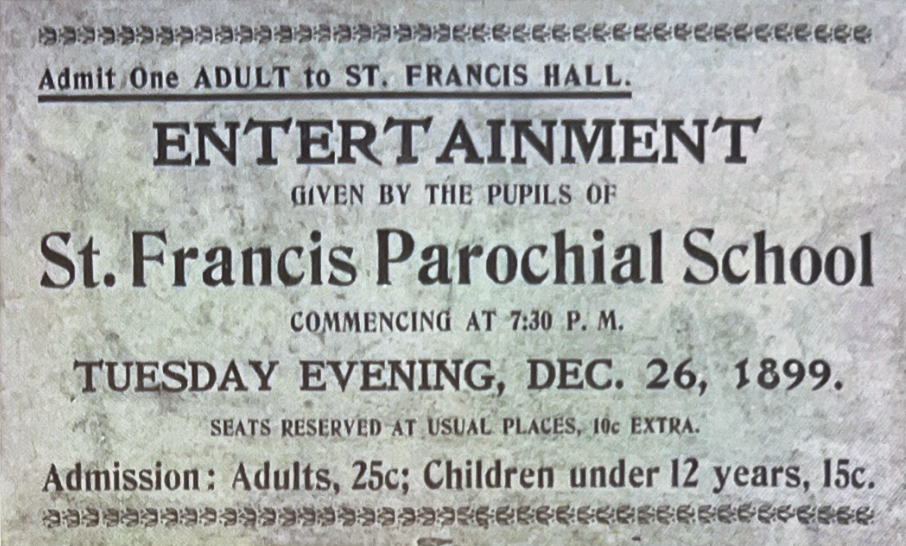
On the Friday afternoon before Christmas, girls were rehearsing the ninth scene of the Christmas pageant in the third-floor auditorium of the school. It was the tableau at the manger. They were dressed as the sheep, with cotton batting sewn onto their nightgowns and masks covered in cotton, and they had gathered in one of the small dressing rooms above the stage to get ready. Thirteen children and Sister Theotima were in that room, and a last-minute visitor made fourteen: Celia VonderHaar, who was to be an angel, had come in to watch the others. The dressing rooms in that loft opened onto one narrow stair and nothing else.
A girl adjusting her mask caught the lamb's wool on the gaslight. She ran for the door, and in running she set the others alight. Sister Theotima tried to beat out the flames with her hands until her veil caught fire. Three more sisters and Fr. Andrew came, and their own robes were more hindrance than help. The hall below held five hundred children.
Twelve girls died, some within minutes, the rest before the day was out. They were eight, nine, and ten years old. Sister Theotima's hands were burned so badly they had to be amputated; they were buried with the girls. There was no accident insurance and no workmen's compensation in 1899, and so the heroine of the fire was sent to the motherhouse in Milwaukee for the rest of her days.
They were buried on Christmas Eve. Seven hearses went out, crowds stood in the cold waiting for the funeral procession, and five thousand people came to the cemetery. Eleven of the children were laid in St. Boniface Cemetery, and because the Irish and the Germans of that generation did not bury together, Mary Hickey was taken to St. Peter's. That is not where the story ends. Before the monument was raised on October 24, 1900, the Hickey family gave their permission, and Mary was brought back to lie beside her classmates. All twelve are together.
May God in His infinite mercy prevent the recurrence of a similar calamity in the future.
The parish chronicler, closing his account
The twelve
Their names are cut into the base of the monument in St. Boniface Cemetery, where it still stands.
- Irene Freiburg
- Josephine Bohne
- Bernadine Freund
- Mary Hickey
- Wilhelminia Kottendorf
- Coletta Middendorf
- Olivia Timpe
- Mary Wavering
- Mary Althoff
- Margaret Werner
- Maria Futterer
- Celia VonderHaar
They were eight, nine, and ten years old. Three other girls were burned and lived: Laura Menke, Helena Soebbing, and Eleanor Timpe.
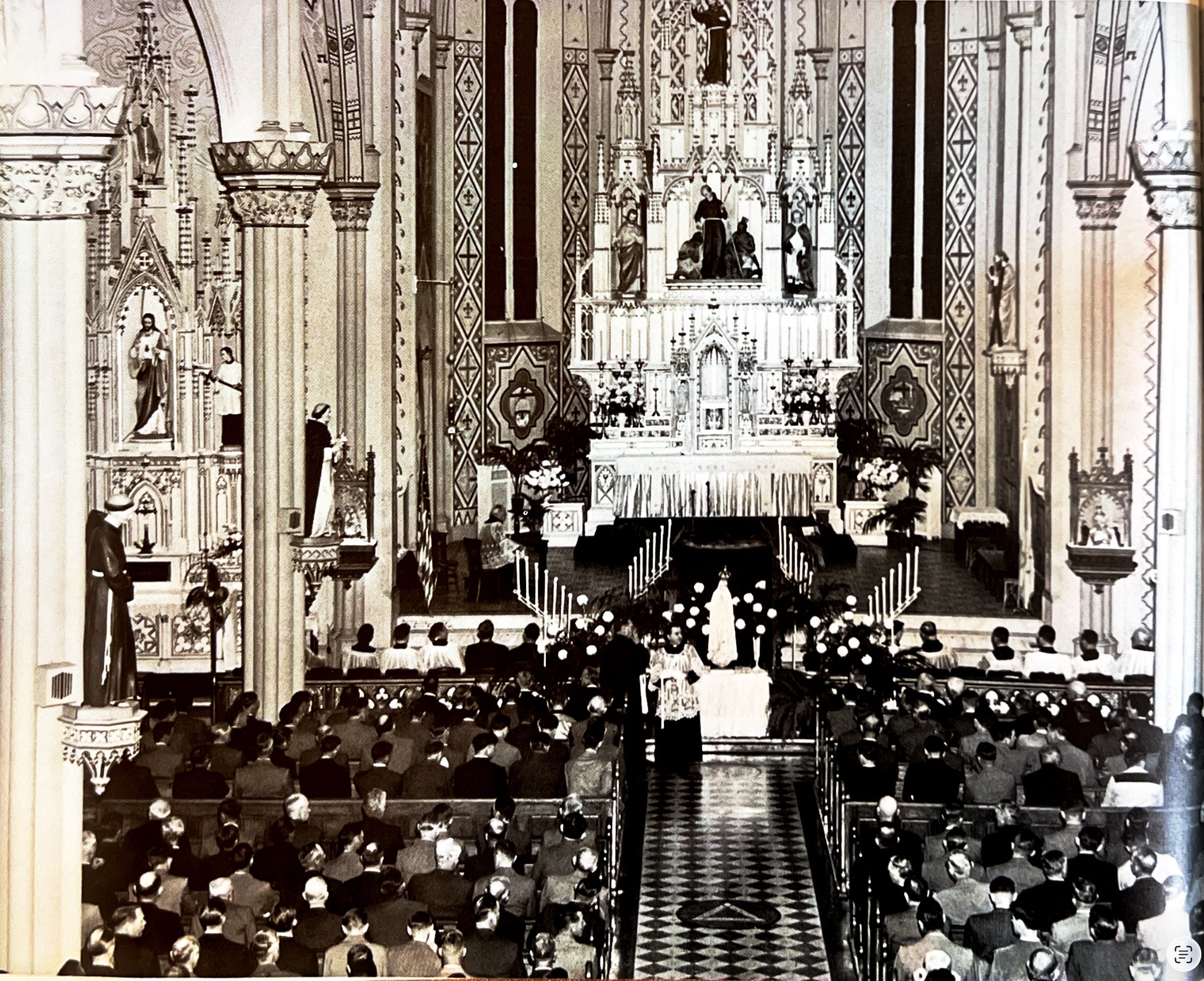
The Sunday a German parish heard English
In March 1919, Fr. Optatus Loeffler read the Sunday announcements in English, and eyebrows went up all over the church. A priest with a name like Loeffler, speaking English in the house of God: ungehört. He had spent years as a missionary among the Chippewa in Wisconsin before Quincy, and he was unbothered. The war had made everything German suspect, and he judged that his people's parents and grandparents had been in America sixty years by then. They were Americans. The language could change without the faith changing with it.
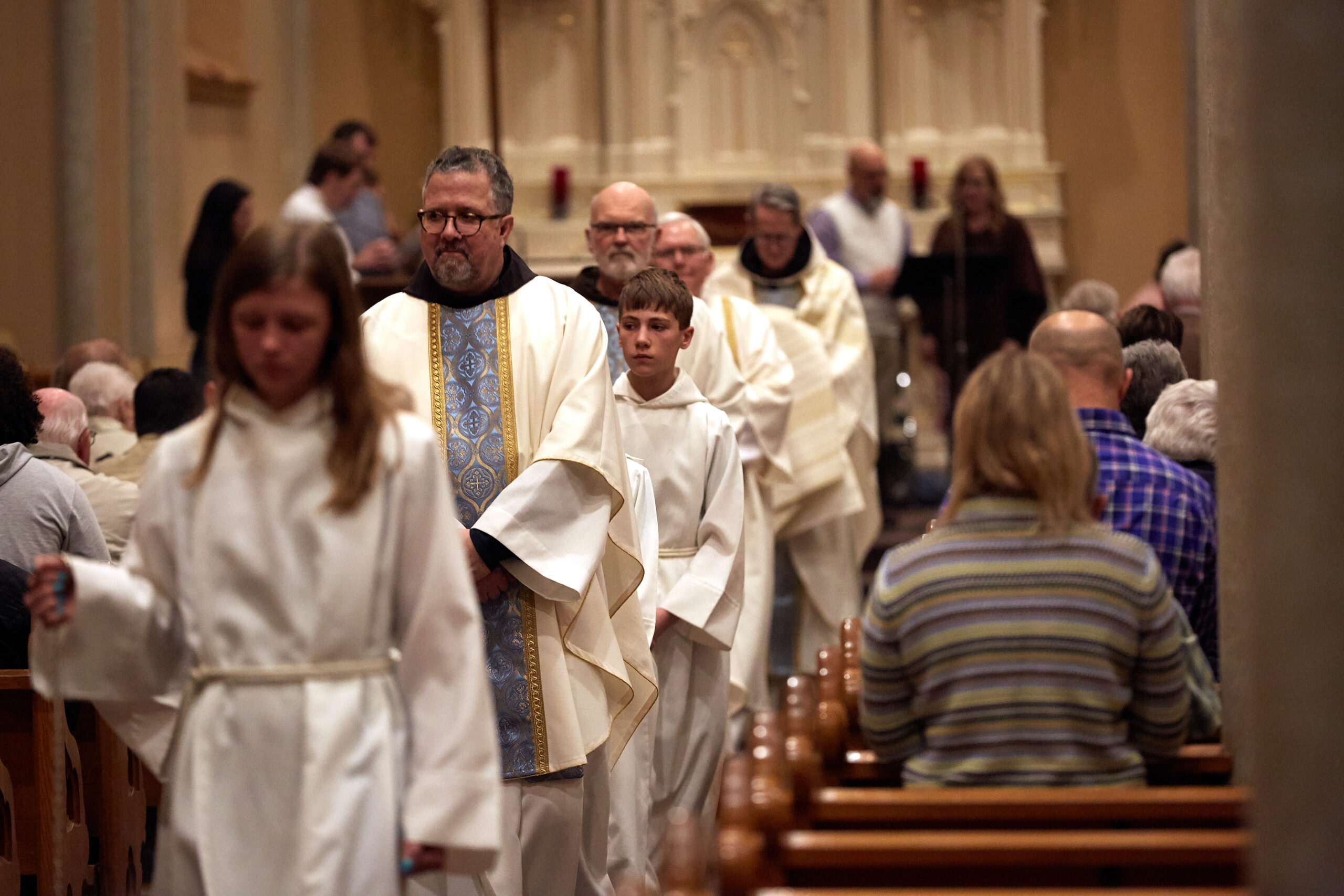
Fifty years later the parish went through it again. The altar turned to face the people in 1965. The Mass came into English in November 1969, and the Saturday evening Mass began in 1970. Men and women began conducting the Service of the Word from the pulpit, to no small astonishment.
The parish history, written by Fr. Francis Jerome Grey, is honest about how that landed.
Our parish is an old conservative one. Change was difficult for the laity and clergy alike; we have all become attached to the familiar ways of doing things.
Fr. Francis Jerome Grey
And a few lines later, about hearing the readings in English for the first time: "Oh what a joy to many, especially the elderly, to understand the meaning of the readings and actions for the first time."
Both things were true at once. They usually are.
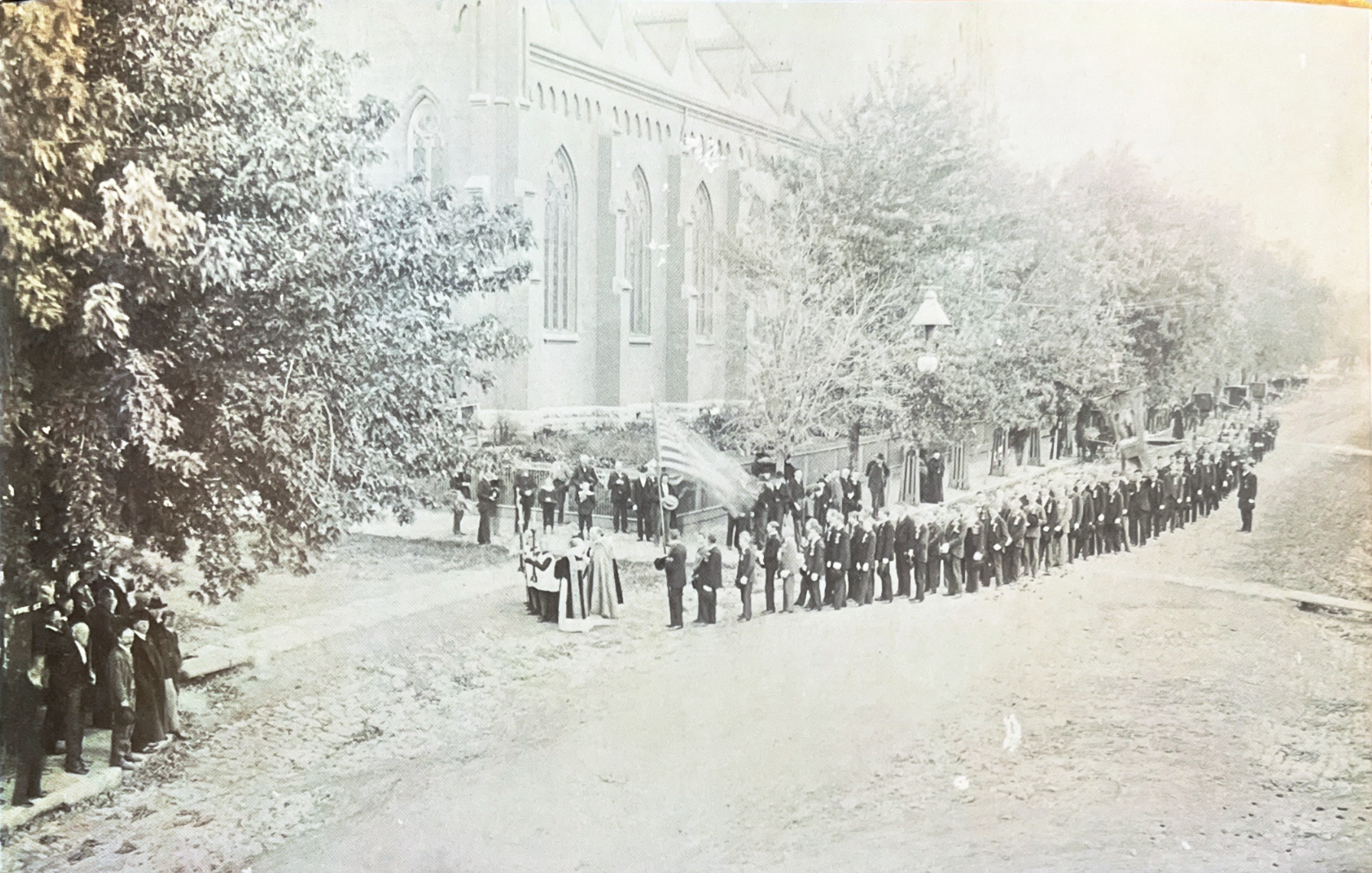
Brother Martin
Brother Martin Lang came to St. Francis in the 1940s and cooked for the friars until illness took him out of the kitchen. He became the sacristan, kept the parishioners' contribution records, and trained the altar boys, which everyone understood to be the work he actually loved. The parish named him Man of the Year in 1971 on his golden jubilee.
He was struck by a car crossing Eighteenth and College on the night of January 20, 1984. It was dark, he was bundled against the cold in coat, hat and ear flaps, and he neither saw nor heard the car. The history says he had announced at dinner that very night that his work was complete.
People are not fools. They can sense the genuine from the fraud. They could sense that in Brother Martin they came near to a man who walked and lived in the presence of God.
The parish history
He is one man out of a hundred and sixty-five years of them. There were the Ladies of St. Francis, running card parties and cleaning the church, whose work one history describes as moving unnoticed like the works of a clock. There were the men of the Building Society and their quarters, the Young Men's Society, the choir, and the families who by 1930 had already given fifteen sons to the priesthood and fifty-one daughters to religious life.
The Franciscans go home
In 2020, after a hundred and sixty years, the Franciscan Order turned the care of this parish over to the Diocese of Springfield, and Fr. Arisman became the first pastor in our history who was not a Franciscan.
It is hard to overstate what ended. The friars founded the parish, built both churches, drew the plans, carved the altars, taught the first classes, cooked the meals, and buried the dead, from 1860 until living memory. The parish keeps the name of a Franciscan missionary and keeps his way of doing things, which was never complicated: stay poor, stay useful, stay put.
In 2025 the pastors of Quincy's four Catholic parishes with schools, with Bishop Paprocki, adopted new bylaws binding their schools together as Quincy Catholic Schools. It's the same instinct that built this place, pointed at the next hundred years.
The 1985 history put it better than we can.
"In all honesty, the history of a parish can never be written. We can at best describe the externals of brick and mortar. It is the lives of people that are important."
A hundred and sixty-five years, briefly
The milestones, from a borrowed building at Maine and Eighth to Quincy Catholic Schools.
-
The first Bishop of Alton sails to Europe looking for German-speaking priests for southern Illinois.
-
The order agrees to the Quincy foundation at its chapter in Wiedenbrück. On December 2 the first two friars reach Quincy from Teutopolis, and by month's end a rented building at Maine and Eighth holds a school, their lodging and a chapel.
-
Christian Borstadt gives the ground at Eighteenth and College. The cornerstone is laid July 2, hours after the bishop ordains three young friars at St. Boniface. The parish is born at the Christmas Midnight Mass: snow swirling up the aisle, ten benches, not full.
-
Forty children walk over from St. Boniface and the parish school opens in a borrowed orphanage building.
-
The School Sisters of Notre Dame arrive to take charge of the school. They will stay more than a century.
-
St. Francis Solanus College, now Quincy University, gets a building of its own across the street.
-
Fr. Nazarius organizes the St. Francis Building Society. Every wage-earner in the parish begins putting in twenty-five cents a week.
-
Fr. Nazarius dies on a train near Dallas, sent south for his health, without seeing the church built. The schoolchildren put up a stone to him.
-
The present church is dedicated on October 24: 182 feet long, a steeple of 200 feet, $62,000 in gold. The 1985 parish history still called it the largest parish church in the diocese.
-
The bells and the tower clock are added.
-
Twelve girls die in a fire during a Christmas play rehearsal in the school auditorium. They are buried on Christmas Eve.
-
The Sisters' convent is built across from the entrance of the church.
-
Fr. Optatus reads the Sunday announcements in English for the first time. Not everyone is pleased.
-
The parish makes the school free, supported by a monthly envelope from every family.
-
The present school is dedicated, pledged for in the spring of 1930 and paid off through the Depression.
-
St. Francis builds St. Dominic's for the east side of Quincy, as St. Boniface once built St. Francis.
-
The altar turns to face the people. The Mass comes into English in November 1969, and the Saturday evening Mass begins the year after.
-
A new friary opens, with a meeting room named for Brother Martin Lang, panelled in wood from the old refectory.
-
The parish marks 125 years, and publishes the history most of this page is drawn from.
-
The St. Francis Parish Center opens, built for several million dollars raised by parish campaign. In July a straight-line wind takes slate off the steeple and tears up the church roof; both are rebuilt.
-
After a hundred and sixty years, the Franciscans hand the parish to the Diocese of Springfield. Fr. Arisman becomes our first pastor who is not a Franciscan.
-
Quincy's four Catholic parishes with schools adopt new bylaws binding them together as Quincy Catholic Schools.
A few things worth knowing about this building
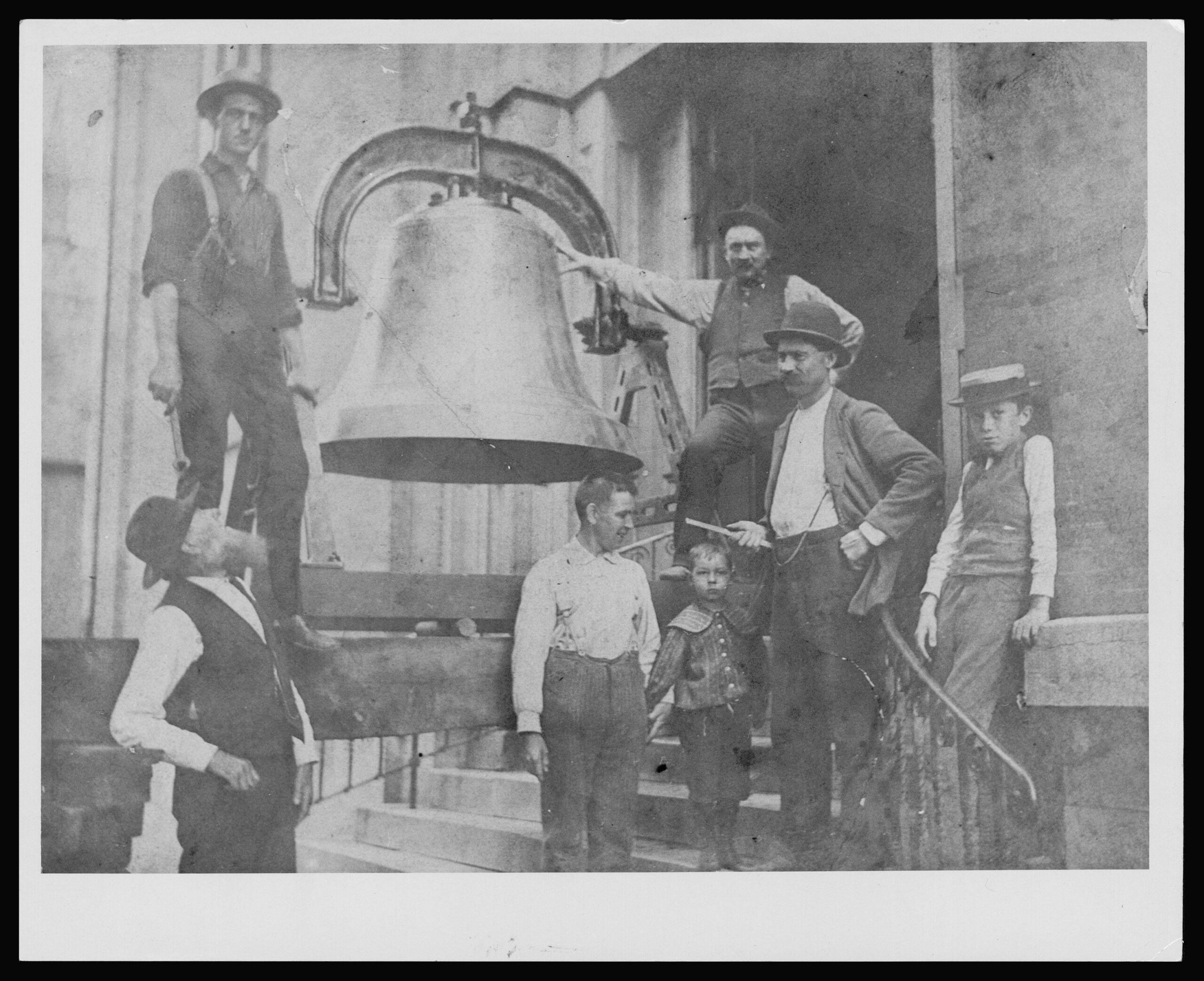
St. Boniface gave this parish its first bell, and it cracked. Two new ones were consecrated in December 1864, the larger named for the Blessed Virgin, the smaller for St. Francis Solanus.
The rector of St. Francis preached at Fr. Tolton's first Mass in Quincy. Augustus Tolton, the first Black priest in the United States and a student at St. Francis Solanus College here from 1878, came home ordained from Rome in the summer of 1886. The Quincy Daily Journal of July 17 reported that he would sing solemn high Mass at St. Boniface the next morning, and that "the rector of St. Francis monastery will preach the sermon in English." Three months later this church was dedicated, with Tolton a priest of this city.
At its peak this parish ran seven Masses every Sunday. In 1887 there were three, the first at five in the morning. By 1960 the Sunday schedule was 5, 6, 7, 8 for the High Mass, 9:30, 10:30 and 11:30, with five more Masses every weekday starting at half past five, and confessions on Saturday from half past two till six, then again from half past seven till nine.
The first wedding here was on November 7, 1861: G. C. Damhorst and Theresa Mann. The first funeral had come a few weeks earlier, for Maria Weillard, in September.
The first church made do with a $54 reed organ that somebody had to pump by hand. In 1864 the parish commissioned a real pipe organ from Joseph Gratian of Alton for $1,362. The statues came from a Mr. Schroeder in Cincinnati, and a Mr. Stadler came up from St. Louis to do the painting.
There were 25 baptisms here in 1861. By 1878 there were 126 a year, and the parish had nearly as many schoolchildren as St. Boniface.
Nobody was seriously hurt building the church. Two years of stonework and scaffolding, and the parish history records not one accident worth mentioning. They credited St. Joseph, to whom they had been praying about it.
Thirteen firms built this church, and the parish history names every one. Stone by F. W. Menke & Co., brick by Albert Schneiders & Co., carpentry by H. Schenk, plastering by J. Eiff & Co., slate by Ad. Braun, painting by F. Taap and Theodore Kemner, joinery by M. Arnold & Co., glazing by G. A. Misch of Chicago, decorative work by L. Loeffler of Milwaukee, pews by Menke & Grimm, the communion rail by B. Elling, boilers by J. H. Michelmann and heating by Backer, Smith & Co. Several of those names are still in the parish, and still in the same trades.
You can go and put your hand on the cornerstone. It was laid on April 26, 1885, at the northwest corner, where the choir of the church meets the friary.
There is Latin carved into every seat in the friars' choir. Brother Isidore Tretelski built the stalls; Fr. Francis Solanus Hilchenbach, reckoned the most learned Franciscan of his day, picked a verse of the psalms for each one. The parish history claims the work "ranks favorably with the best in the world."
Forty of the fifty statues in the church are wood, carved in Germany. In 1948 a School Sister of Notre Dame, Sister Victorine, cleaned and touched up every one of them herself.
One of the 1892 bells is inscribed against fire and storm: "O Agatha, protect this Home from lightning's harm and blight; avert disaster, conflagration, tornado's dreadful course." The tower has since taken two of the three. Lightning struck it in the 1990s and set a small fire. On July 13, 2015, a straight-line wind came across Quincy and stripped slate off the steeple, brought down the decorative finials at its base and tore up the roof of the church. Both times it was repaired.
The steeple is slate. The roof only looks like it. After the 2015 storm there wasn't enough cement-asbestos shingle left anywhere to patch the church roof, so it was replaced in synthetic slate. The steeple was redone in the real thing, and four new metal finials were engineered and set back at its base.
Five things moved out of the old church and into this one: the high altar, both side altars, the organ, the confessionals and the sacristy cabinets. Then the old church was pulled down.
The 1915 organ builder got the job partly for being Catholic. Wicks of Highland, Illinois beat out Estey of Vermont and Kilgen of St. Louis, and Fr. Didacus Gruenholz noted approvingly in a letter that they "conduct a factory where Romanism has its way."
That organ is now in Wisconsin. It was sold in 1984 to the University of Wisconsin–Platteville, where it took two years to rebuild and still plays. Ninety-seven of its facade pipes stayed behind in our balcony to cover the space it left.
The organ here now was built in 1928 by E. M. Skinner for St. Joseph Cathedral in Columbus, Ohio. The parish bought it in 2005 and had it cut down to fit this building, in memory of Jerry Fischer, who had learned to play on the organ that left.
On one morning in June 1930, three sons of this parish sang their first Masses here, at six o'clock, at eight, and at ten. By that day St. Francis had given fifteen men to the priesthood and fifty-one women to religious life.
The church lighting once won a prize. A system installed in 1947 was built so well that it took an award at the Third International Lighting Conference in Chicago two years later.
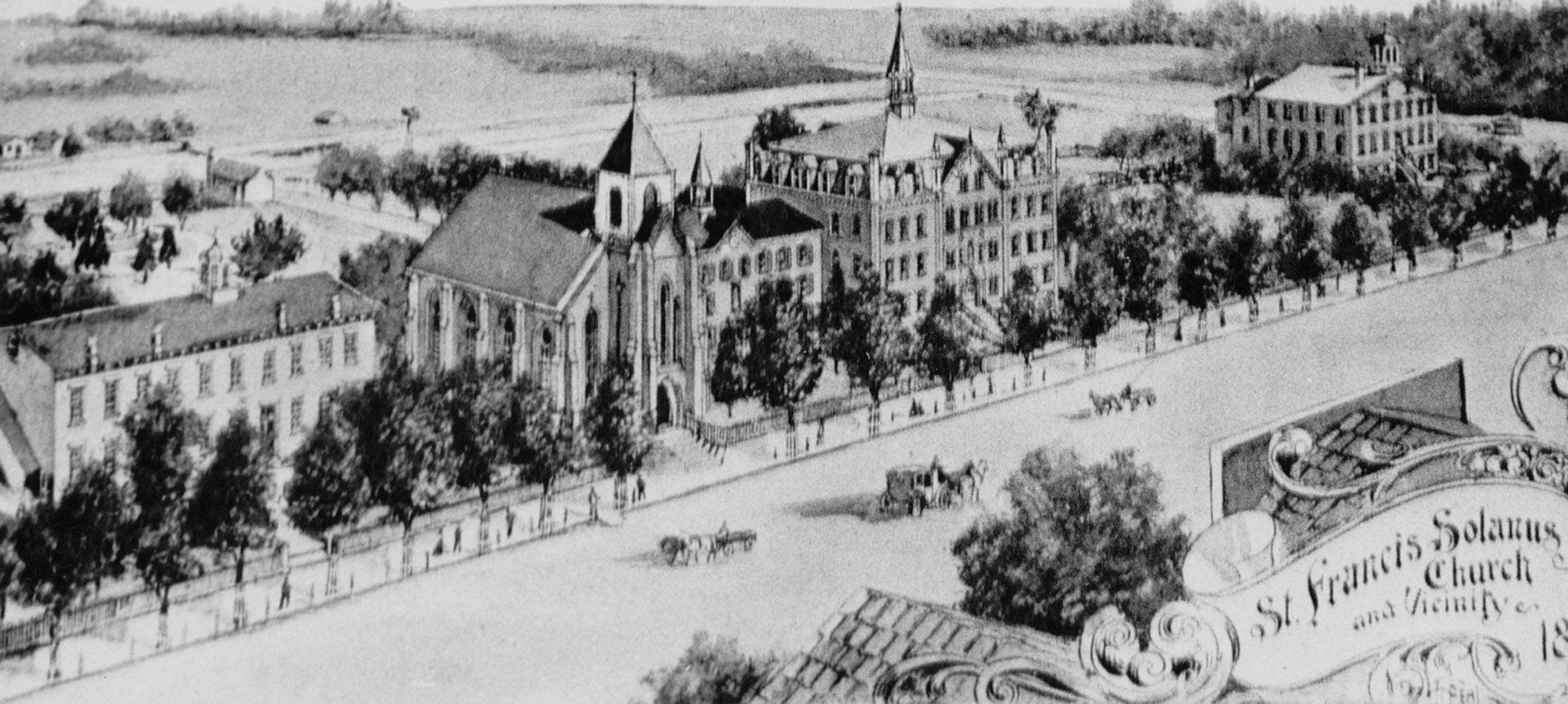
In 1918 the pastor paved College Avenue for $5,406.56, which the parish history describes as taking St. Francis "out of the mud." A hundred and three years later the city gave the street back. The parish closed it, and the church and the school now stand on one piece of ground.
You're welcome here.
The church is open, and Mass times haven't changed much in a hundred and sixty years. Come see it.