
The readings this Sunday speak to us about something that is often much easier to talk about than to practice: Forgiveness. Sirach reminds us that anger and resentment can become burdens we carry within ourselves. When we hold on to an offense, rehearsing again and again what someone has done to us, we can slowly become prisoners of the very hurt we refuse to release. Sirach asks a challenging question: “Could anyone refuse mercy to another like himself, and can he seek pardon for his own sins?” We come before God each week conscious of our own need for mercy. None of us stands before the Lord with a perfect record. We are all sinners in need of forgiveness. Therefore, the mercy we receive from God should become the mercy we are willing to extend to others.
In the Gospel, Peter asks Jesus how often he must forgive someone who sins against him. Peter probably thought that seven times was already extraordinarily generous. Jesus responds by taking forgiveness beyond all human calculation: seventy-seven times. In other words, forgiveness is not something we keep a ledger for. Jesus then tells the parable of the servant whose enormous debt is forgiven, only for that same servant to refuse mercy to someone who owes him a much smaller debt. The lesson is unmistakable: We cannot truly appreciate God’s mercy toward us while refusing to show mercy to others.
Forgiveness does not mean pretending that an injustice never happened, nor does it always mean that trust is immediately restored. It means placing our hurt into God’s hands and refusing to allow resentment to have the final word. As we pray the Lord’s Prayer, “forgive us our trespasses, as we forgive those who trespass against us,” may we recognize that these are not merely words we recite, but a way of life to which Christ calls us.
Starting next weekend once a month, the school children will take all of the roles that they can in serving at Mass. It will rotate Masses. Please encourage them as they learn to give of themselves more and more to the Lord.
Also, in my bulletin article, I’m going to try to give one paragraph every week from the Catechism of the Catholic Church. Please enjoy.
I. The life of man – to know and love God
1.- God, infinitely perfect and blessed in himself, in a plan of sheer goodness freely created man to make him share in his own blessed life. For this reason, at every time and in every place, God draws close to man. He calls man to seek him, to know him, to love him with all his strength. He calls together all men, scattered and divided by sin, into the unity of his family, the Church. To accomplish this, when the fullness of time had come, God sent his Son as Redeemer and Saviour. In his Son and through him, he invites men to become, in the Holy Spirit, his adopted children and thus heirs of his blessed life.
Pax et bonum,
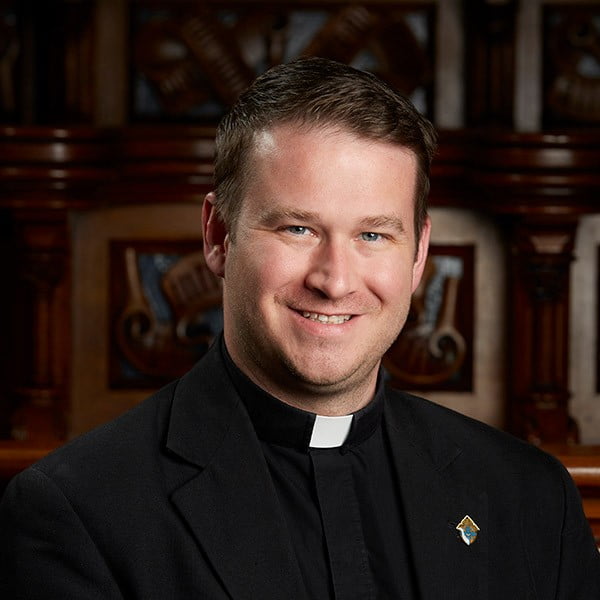
Father Arisman